Tool Distribution Drift in 1,960 Tau-Bench Agent Trajectories
TL;DR. We ran an entropy-based tool distribution drift detector across 1,960 tau-bench customer-service agent trajectories (GPT-4o + Sonnet 3.5 New, retail + airline). 39.8% of trajectories with ≥8 tool calls show measurable collapse (Δ entropy ≥ 0.3 nats); 12.1% collapse hard (Δ ≥ 0.5 nats). The signal is bimodal — agents either stay open or fall off a cliff. Sonnet 3.5 New on retail tasks collapses 1.7× more than GPT-4o on the same task family.
This post is the result of running Aegis's entropy-based drift detector (src/aegis/core/drift.py) over the public sierra-research/tau-bench historical_trajectories dataset. All measurement code, raw data, and chart-generation scripts are linked at the bottom.
What we measured
For each tau-bench trajectory we extracted the ordered tool call sequence (think · find_user · get_order_details · …) and computed Shannon entropy of the tool name distribution over two non-overlapping windows:
- early window = the first 4 tool calls
- late window = the last 4 tool calls
- drift =
entropy(early) − entropy(late)(positive means the tool mix narrowed over time) - collapse threshold = drift ≥ 0.3 nats (≈ 26% of
log 4, the maximum possible entropy of a 4-call window)
We restricted analysis to trajectories with ≥8 calls (to leave room for two non-overlapping windows). That left 812 of 1,960 trajectories scorable.
Finding 1: drift is bimodal — agents either stay open or fall off a cliff
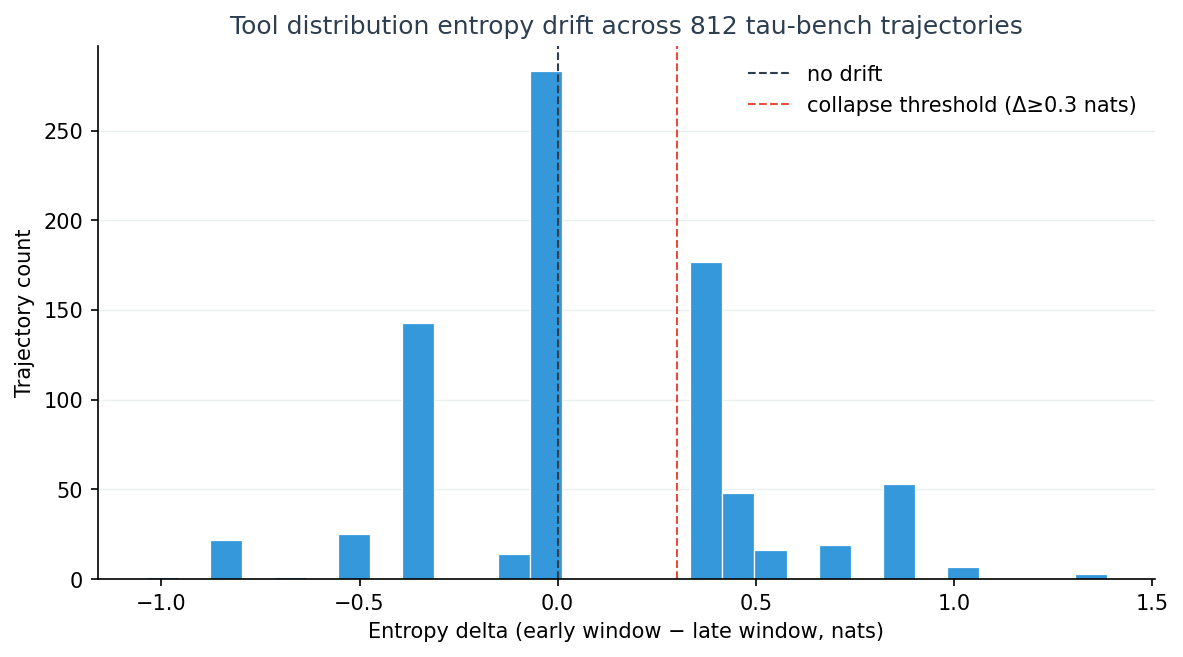
The distribution has two modes: a tall bar near zero (no drift, the agent maintained tool diversity through the full task) and a second peak around Δ = 0.4 (a hard collapse, the agent narrowed onto one or two tools by the end). Almost no trajectories sit in the "gradual decline" middle. An agent either holds its exploration breadth or it doesn't.
Finding 2: model and domain matter, and the gap is large
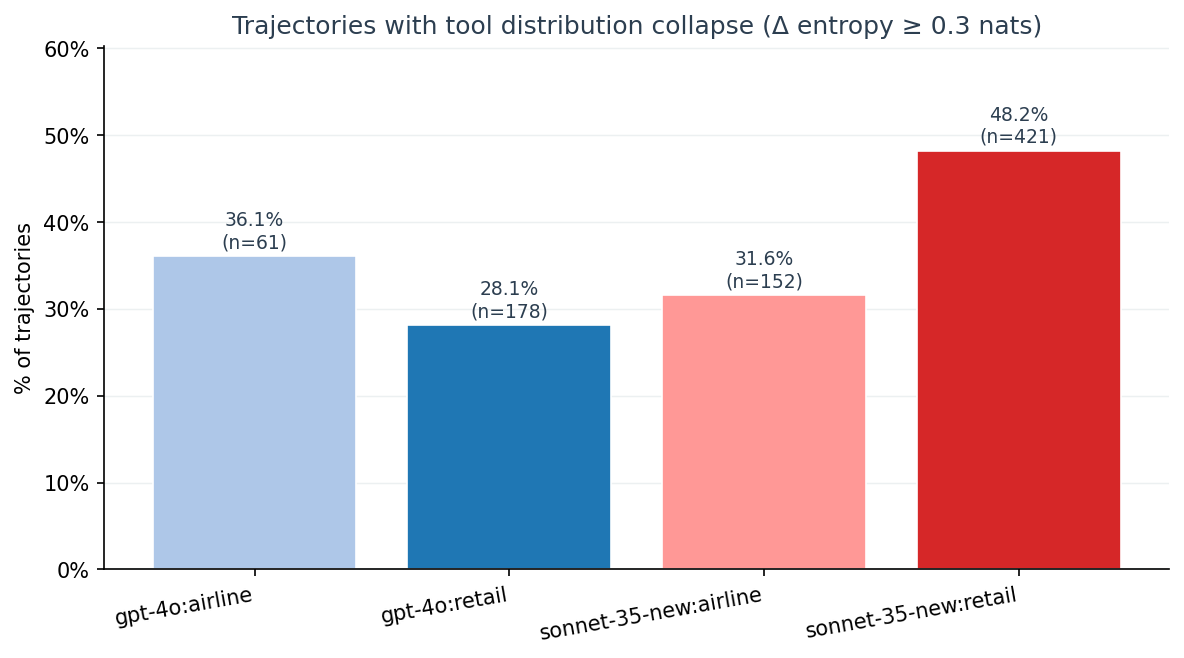
| Model:domain | Trajectories scored | Collapse rate (Δ ≥ 0.3) |
|---|---|---|
| sonnet-35-new : retail | 421 | 48.2 % |
| gpt-4o : airline | 61 | 36.1 % |
| sonnet-35-new : airline | 152 | 31.6 % |
| gpt-4o : retail | 178 | 28.1 % |
On the same retail task family, Sonnet 3.5 New collapses on 48.2 % of trajectories versus GPT-4o's 28.1 %. That's 1.7×, on n = 599 combined trajectories.
We are not claiming "Sonnet is worse." Customer-service tasks reward narrowing — once the agent has located the user and the order, the remaining steps converge on a small set of fulfilment tools. What the data shows is that the convergence is sharper and earlier in Sonnet. Whether that is a feature (decisive execution) or a failure mode (premature commitment) is task-dependent.
Finding 3: drift magnitude grows with trajectory length
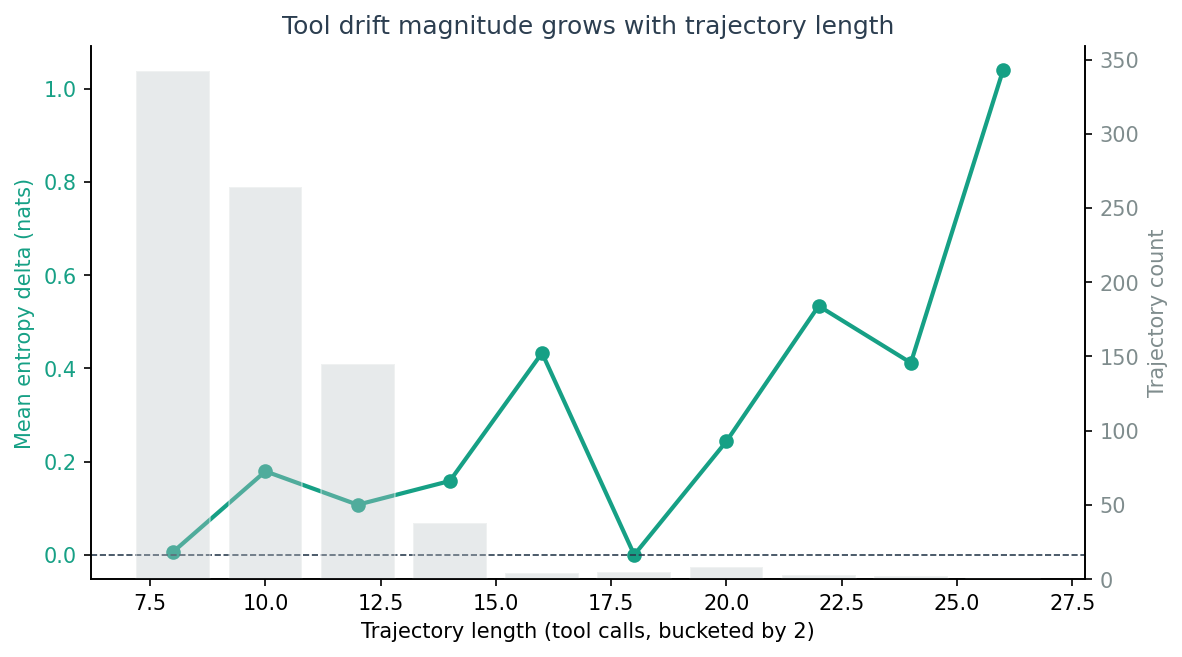
Mean entropy delta climbs from ≈ 0 nats at length 8 to ≈ +0.6 nats at length 26+. Longer trajectories drift more in absolute terms — which is consistent with both interpretations:
- (a) Long tasks legitimately need to converge; the late window samples a fulfilment-heavy phase.
- (b) Long tasks expose agents to more compounding pressure to reuse the most recently-successful tool.
The reverse cumulative chart sharpens the per-group picture:
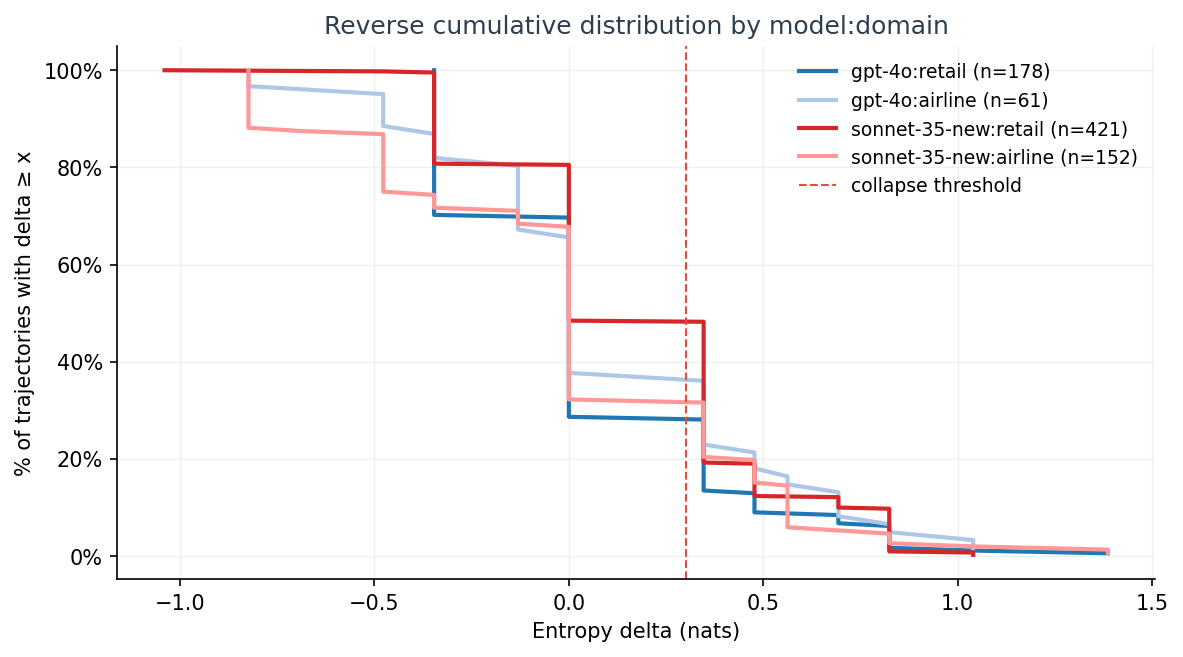
The Sonnet retail curve sits visibly above the others all the way out to Δ ≈ 1.0. Across the entire upper tail, Sonnet retail trajectories are more likely to be in collapse than any other group.
Three trajectories, in their own words
Full collapse (Δ = +1.386 nats, gpt-4o:retail:t0347)
early window:  find_user_id_by_name_zip → list_all_product_types →
               get_product_details → get_user_details
late window:   get_order_details → get_order_details →
               get_order_details → get_order_details
log 4 = 1.386 (perfectly uniform) to 0.0 (one tool, four times). The agent moved from open exploration to a single-tool loop within 8 calls.
Mid collapse (Δ = +0.477 nats, gpt-4o:retail:t0279)
early window:  find_user_id_by_name_zip → get_user_details →
               get_order_details → get_order_details
late window:   get_order_details → get_order_details →
               get_order_details → exchange_delivered_order_items
Stable (Δ = +0.000 nats, sonnet-35-new:retail:t0441)
early window:  find_user_id_by_name_zip → get_user_details →
               get_order_details → get_order_details
late window:   get_product_details → think → exchange_delivered_order_items →
               think
Why measure this at all?
A drifting tool distribution is not a bug by itself, and we are explicit about not claiming otherwise. But it is one of the few signals you can compute on a tool-call trace that simultaneously satisfies four properties most existing approaches give up at least one of:
1. Deterministic (no LLM-as-judge)
The entire pipeline is Counter, log, and mean. No second model judges the first model. No fine-tuned classifier. No retraining. Two runs on the same trace produce bit-identical results — which means we can compare GPT-4o output today to Sonnet output tomorrow without worrying that the evaluator drifted between runs.
Most agent-quality work today uses LLM-as-judge (Patronus, Braintrust, DeepEval style), or fine-tuned classifiers (Galileo, Maxim). Both add a second source of variance. Entropy doesn't.
2. Privacy-preserving (tool names only)
The score function only reads tool_name. Arguments, chain-of-thought text, user prompts, and system prompts can all stay on the agent's machine. This means:
- Enterprise users can run drift detection on prod traces without exfiltrating PII or proprietary prompts.
- The detector can be embedded in
auto_instrument()middleware that streams a 1-byte-per-call summary instead of full trace bodies. - Public benchmarking is honest — we are not silently leaking the evaluation set into a hosted API.
LLM-judge tools by definition need to read the actual conversation; they can't offer this property at all.
3. Cross-model comparable
Because the metric is computed on the trace alone, GPT-4o and Sonnet produce numbers on the same scale (Δ ∈ [-log W, +log W], normalised to [-1, +1] against log W). The Sonnet-retail vs GPT-4o-retail comparison earlier in this post (1.7× collapse rate) is only possible because the metric is model-agnostic.
Most published agent benchmarks measure single-model accuracy on a fixed test set ("our agent solves X% of HumanEval"). They cannot tell you whether a different model on the same trajectory behaved differently — and that's the question buyers actually have when picking between Sonnet and GPT-4o.
4. 30-second reproducible
The entire measurement pipeline (loader + scorer + group aggregator) is 120 lines of stdlib-only Python. No numpy, no pandas, no sklearn. The dataset is public (sierra-research/tau-bench). The scripts are linked at the bottom of this post. From git clone to regenerated charts takes about 30 seconds on a laptop.
This matters because most "we measured X" claims in the agent space either ship the numbers without code, ship code without data, or require GPU infrastructure to reproduce. We took ~3 hours of compute on a CPU laptop.
What it doesn't do
- It does not say why the agent collapsed.
- It does not say whether the collapse caused the task to fail.
- It does not work on a single tool call — you need at least 8.
Our prior hypothesis ("CoT cardinal numbers near action verbs are extractable as a drift signal") was killed by the same dataset at a 2.3 % hit rate. The entropy-on-tool-names approach survives where the regex-on-thoughts approach didn't, because it satisfies all four properties above.
Reproduce in 30 seconds
git clone https://github.com/Acacian/aegis
cd aegis
pip install -e .
# (download tau-bench historical trajectories — see scripts/convert_tau_bench.py)
python scripts/analyze_drift_on_tau_bench.py \
    --input .cache/traces/tau_bench_all.jsonl \
    --output .cache/analysis/drift_results.json \
    --window-size 4 --min-calls 8
python scripts/visualize_drift_results.py
This will regenerate every number and chart in this post.
Try the detector on your own agent
import aegis
from aegis.core.drift import DriftDetector, DriftType

detector = DriftDetector()
# Feed it the BehaviorProfile produced by aegis.auto_instrument()
# or build one from your own trace.
result = detector.check(agent_id="my-agent", metric_name=DriftType.TOOL_DISTRIBUTION)
if result.drifted:
    print(f"Tool distribution drifted: Δ={result.delta:+.3f} nats")
A CLI wrapper (aegis check drift --tool-distribution <trace.jsonl>) lands in v0.9.4, due immediately after this post.
Methodology notes & limitations
- Single-task framing. Each tau-bench
tXXXXis one customer task. We treat the full call sequence as one trajectory and ignore turn boundaries inside a conversation. Multi-task agents would need a different windowing strategy. - Window choice. W = 4 is the smallest window that keeps
log W = 1.386enough resolution to detect 0.3-nats moves. Larger W (8, 16) makes collapse harder to detect because window-internal averaging smooths the signal; smaller W is too noisy. - Cause attribution is out of scope. We do not claim that tool distribution collapse causes task failure. We only show that the signal exists, varies systematically by model and task family, and is cheap to compute.
- Sonnet 3.5 New ≠ Sonnet 4.5/4.6. The tau-bench dataset shipped with Sonnet 3.5 New. Numbers may differ on more recent Sonnet checkpoints.
- n is not enormous. 812 scorable trajectories is enough to see directional differences but not enough for statistical significance claims at the per-tool level. Treat the percentages as descriptive, not inferential.
Data and code
- Measurement script:
research/tau_bench_drift/analyze.py - Visualization script:
research/tau_bench_drift/visualize.py - Reproduction guide:
research/tau_bench_drift/README.md - Drift detector source:
src/aegis/core/drift.py(Aegis core) - Raw tau-bench data: sierra-research/tau-bench historical_trajectories
- Aegis repo: github.com/Acacian/aegis
If you want the per-trajectory JSON (812 rows × 13 columns), open an issue on the repo.